PanAfGeo Logo
Calendar Icon
EU Emblem

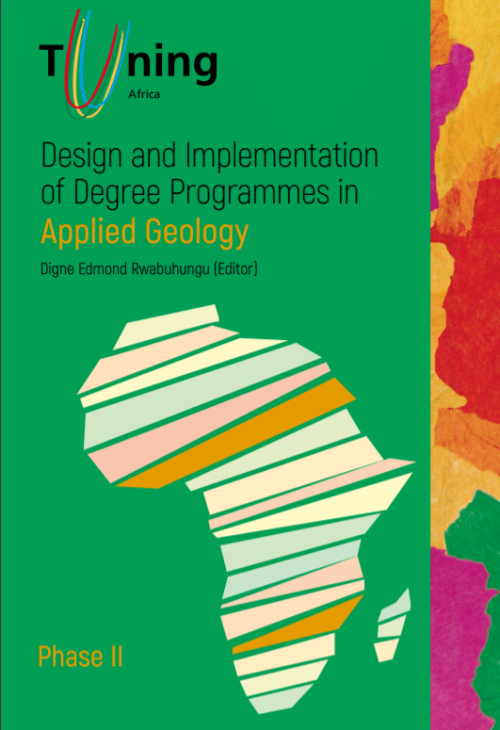
Tuning Africa Project Phase II – Design and Implementation of Degree Programmes in Applied Geology

The harmonisation of higher education in Africa is a multidimensional process that promotes the development of an integrated higher education space on the continent of Africa. The objective is to achieve collaboration across borders, sub-regionally and regionally, in curriculum development, educational standards and quality assurance, joint structural convergence, consistency of systems as well as compatibility, recognition and transferability of degrees to facilitate mobility. Harmonisation is necessary for achievement of the African Union vision of integration, peace and prosperity.

Tuning Africa was adopted as a possible instrument to advance the African Union’s harmonisation agenda, in collaboration with the EU through the Joint Africa-EU Strategy.  Implementing a second phase of Tuning was one of the commitments taken at the 2014 Africa-EU Summit in 2014 in Brussels, as a follow-up to the very successful pilot phase which took place between 2011 and 2013. At the November 2017 Africa-EU Summit in Abidjan, Heads of State committed to deepening their collaboration and exchange in education, aiming at increasing the employability of young people bearing in mind that investing in youth and future generations in Africa is a prerequisite for building a sustainable future. In this context, further concrete initiatives in the field of higher education which aim to enhance relevance and the quality of education and training will be encouraged.

By contributing to the harmonisation of higher education in Africa, Tuning Africa is complementing Erasmus+, the Intra-Africa academic mobility programme and the Nyerere scheme; thereby enhancing the mutual recognition of academic qualifications and facilitating exchanges and mobility of students and staff across the continent and with Europe. This is instrumental for acquiring key skills and competences that are important for employability, facilitating collaborative research addressing common challenges, and for ensuring
relevant and quality education. The dialogue on credits and a common credit system for Africa is another major deliverable for Africa. All these initiatives are in line with the Continental Education Strategy for Africa as well as Africa’s Agenda 2063 which calls for an education and skills revolution.

Tuning Africa has provided a platform for dialogue on quality assurance and the improvement of teaching, learning and assessment in higher education. Bringing together academia and employers, and importantly in this second phase, the active involvement of students, has been crucial. The success of Tuning Africa has been the involvement of a critical mass of universities and stakeholders, the ownership and commitment of all involved, as well as a transparent and credible leadership. The AUC and EC are grateful to all the African and European experts involved in the production of this book, which is an outcome of the Joint Africa-EU Partnership Harmonisation and Tuning Africa 2 initiative.

To know more, click here to view/download the report.

Geoinformation Management- Training session successfully launched WP7-C3, Cape Town, 11-22 Nov 2019

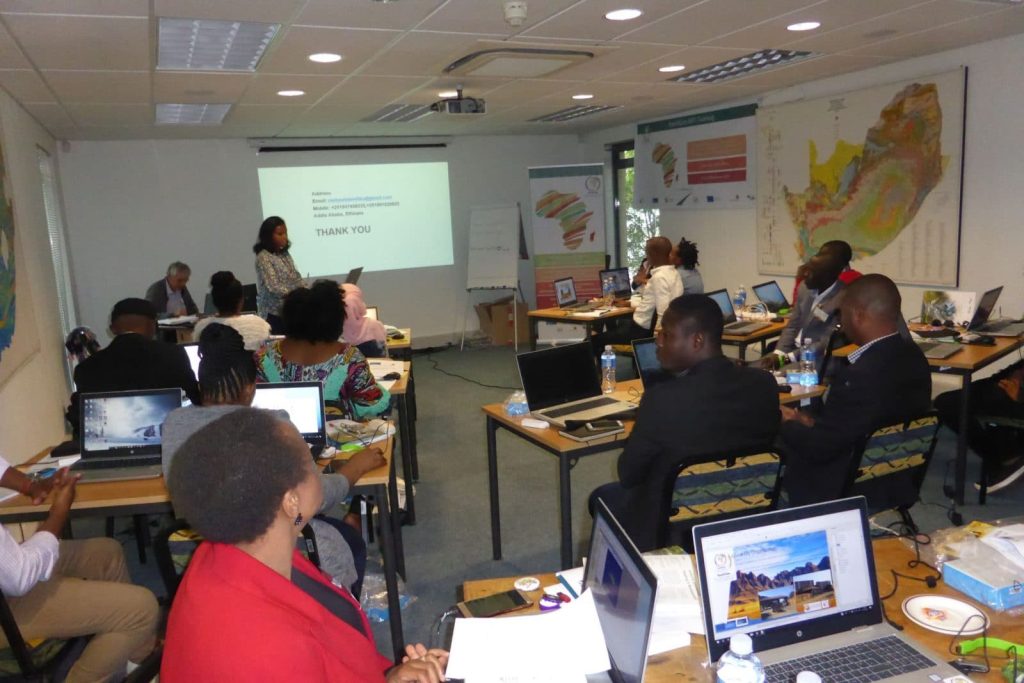
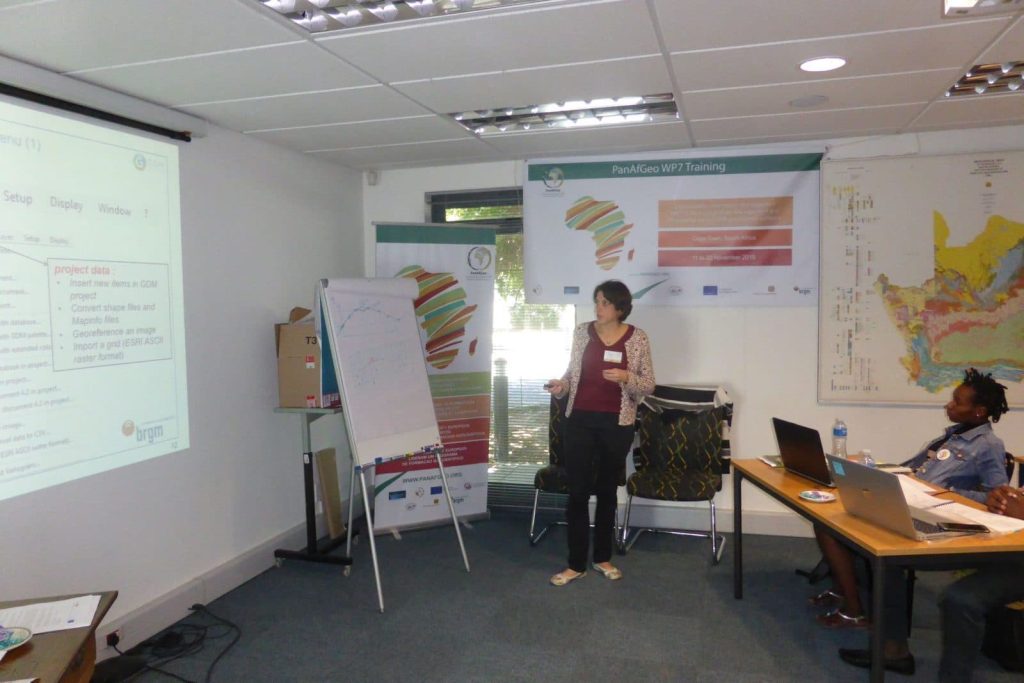
The last WP7 session dedicated to “Geological data management and processing using GDM geoscience software” was successfully launched last Monday 11 November in Cape Town.

This two-week session is hosted by the Council for Geoscience at the Western Cape Regional Office located in Bellville, Cape Town area.

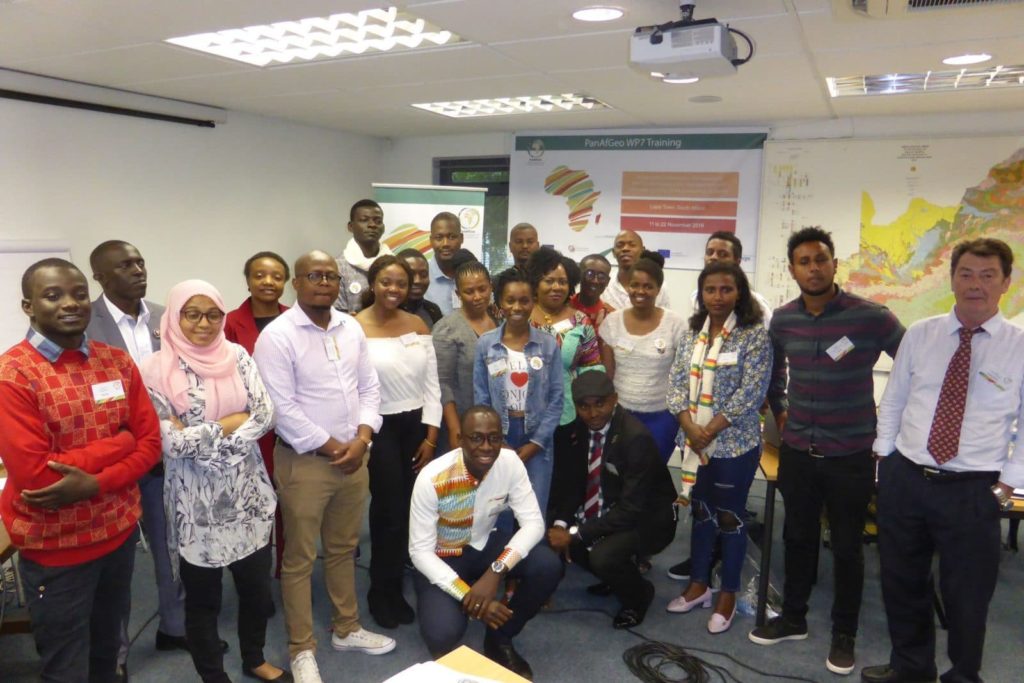
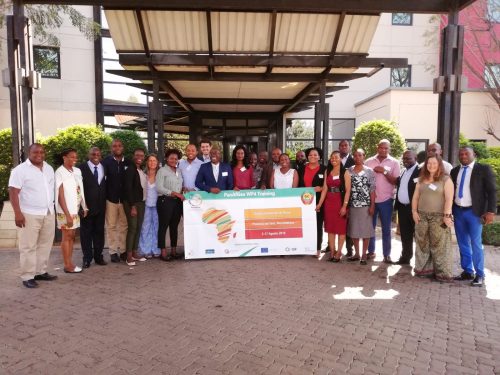
19 trainees (7 women and 12 men) participated in the session representing 11 countries.

They are trained in using GDM (Geological Data Management) software developed by Bureau de Recherches Géologiques et Minières (BRGM) and kindly made available to them with a free one-year licence.

Opening ceremony lead by Dr Luc Chevallier, Senior Special Scientist.

Trainers: Bernard Bourgine, Christelle Loiselet and Yvan Assy (BRGM), and Chiedza Musekiwa (CGS)

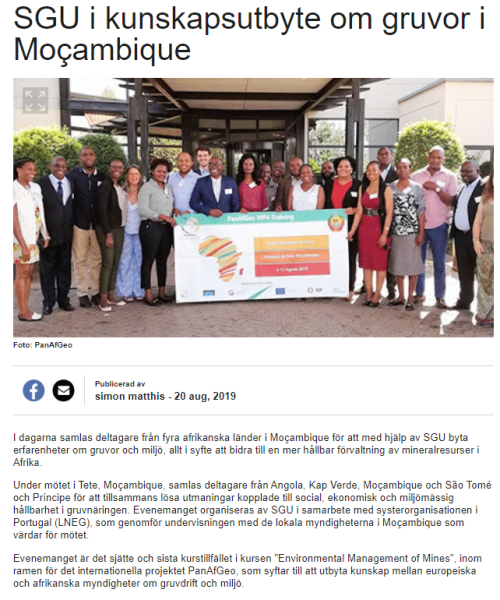
Significant Media Coverage of the sixth Environmental Management of Mines training session in Tete Province, Mozambique (6-17 Aug 2019)

Sixth training in Environmental Management of Mines is over with a significant media coverage:


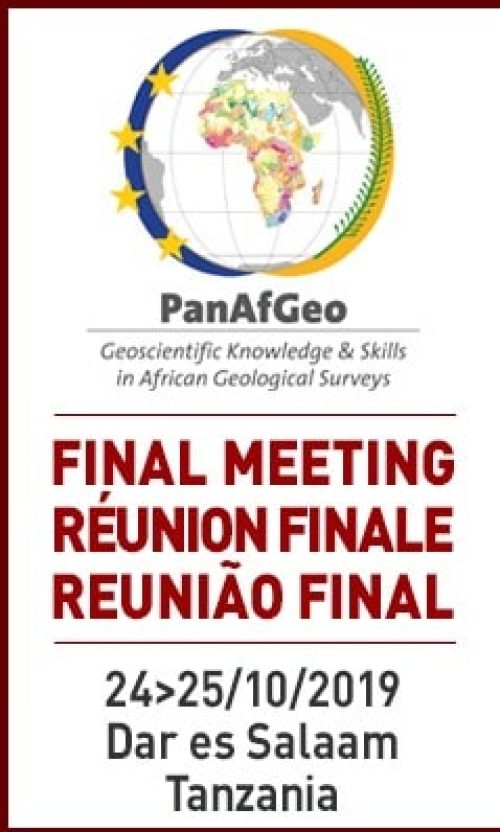
Final meeting of the PanAfGeo Project – 24 & 25 Oct 2019 in Tanzania

The Final meeting of the PanAfGeo project: a 2-day meeting will be held in Dar es Salaam, Tanzania, 24-25 October 2019.

The wide range of professionals and leaders from Africa and Europe will take part in the meeting. Which includes Advisory board, Co-leaders, Consortium, Expert chair and Executive Committee. It is jointly organised by EuroGeoSurveys (EGS), The French Geological Survey (BRGM), African Minerals and Geosciences Centre (AMGC) and the Organisation of African Geological Surveys (OAGS).

Learn more about the PanAfGeo here.

Report of Environmental Management of Mines training session WP4 S6: Tete Province, Mozambique, 6-17 Aug 2019

« ENVIRONMENTAL MANAGEMENT OF MINES »

Tete, MOZAMBIQUE 6-17 August 2019

PANAFGEO FIRST TRAINING IN PORTUGUESE!

« Environmental Management of Mines », the sixth and last session of the training program as part of the PanAfGeo WP4 held in Tete (Mozambique) from 6th to 17th August 2019.

Twenty professionals from four countries – Angola, Cabo Verde, Mozambique and São Tomé and Príncipe – gathered for the first PanAfGeo training in Portuguese in Tete, Mozambique. The training was organized by the Geological Survey of Sweden (SGU) and the National Laboratory of Energy and Geology of Portugal (LNEG) and hosted by the National Directorate of Geology and Mines (DNGM) as well as the National Institute of Mines (INAMI) of Mozambique. The selected candidates for the training represented several organizational units from geological and mining authorities to which they belong. The selected group have expertise in a broad range of topics and includes among other geologists, environmental specialists, mine inspectors and mining engineers.

The sessions were led by a team of professionals from Portugal and Sweden: Judite Fernandes (LNEG), Maria João Batista (LNEG), Jonathan Hamisi (SGU) and Théo Berthet (SGU).

Seminars on mineral resources and environmental management of mines were combined with group discussions and exercises. The training focused on subjects that are directly relevant for the trainees’ daily work. How is environmental management of mines part of their activities? What are the challenges and opportunities? What legal frameworks, organizations, collaborations and interactions are available or could be developed in the future?

All participants presented their organizations and a review of environmental mine management in their respective countries. They also assessed environmental risks, management practices and organizational challenges. Several examples of ongoing and closed mining projects have been presented. Examples of rehabilitation, mine closures, public participation and stakeholder interaction in mining projects have been discussed. The seminars, group exercises, field visits and discussions have been merged into a plan of action that each participant took as a report message to their respective authorities.

Some of the topics included:

  • The regional legal framework,
  • Assessment of the environmental impact of mining activities,
  • Hydrogeology, water and mines,
  • Acid Mine Drainage and Waste Management,
  • Coal and pegmatite mining,
  • Small-scale mining and the environment,
  • Rehabilitation and closure of mines,
  • Public participation, sustainability and post-mining projects.


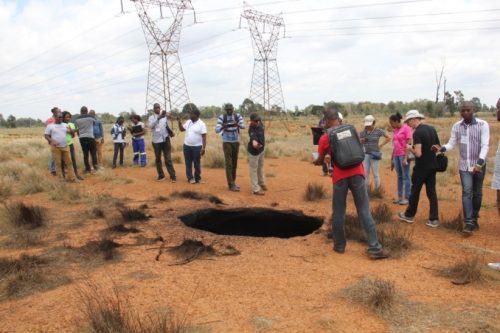
After the seminars, field visits took participants to the Moatize coal mine in the western outskirt of Tete. Moatize coal mine is a large-scale mining project with a yearly output of about 2% of the world coking coal production, a commodity used in steelmaking. We are thanking Vale, and especially Rogerio Sendela, for organizing a three-days visit including lectures about their mining activities, mine facilities visit and community project presentations. On site, participants had the opportunity to be introduced to Vale waste and environmental management plan and share experience in mitigation and prevention of risks related to coal mining in the region. Furthermore, participants had the opportunity to visit the community and resettlement project in the area of Cateme which is located on Vale’s mining license. The group also visited a small scale and artisanal gold mine and discussed the environmental impact of such activity and how a geological survey can provide support for such activity in order to prevent and mitigate related environmental impact.

One of the most important outcomes of the training is the building of a new professional network between the trainees and the trainers. The interactions and sharing of experiences from mining activities, environmental management and governance principles between countries was extremely valuable. The contacts established between the participants and trainers constitute an important and long-lasting contribution of the training and will also benefit the other work packages of PanAfGeo for future training in Portuguese. Several forms of Internet-based communication are already active between participants and trainers. Some basic tools and methods for field work and documentation have been provided to participants.

The training was organised by Mats Thörnelöf, Project Manager (SGU), Jonathan Hamisi, Deputy project Manager (SGU), Théo Berthet (SGU), Judite Fernandes (LNEG), Maria João Batista (LNEGl) and Luís Plácido Martins (LNEG). The successful preparation of the training session was made possible through the work of Elias Daudi, General Director of the DNGM, who also attended the opening ceremony and Grácio Cune, Provincial director of DNGM. The Environmental Management of Mines Training Program is co-funded by the Intergovernmental Forum on Mining, Minerals and Sustainable Development (IGF).

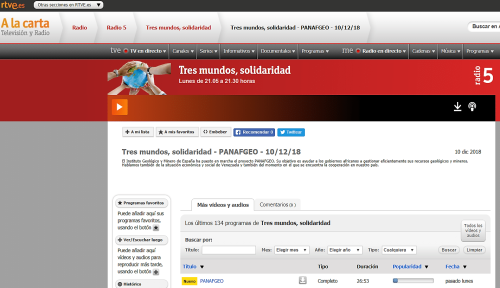
Interview of the PanAfGeo WP6 – Geoheritage leader in the Spanish global radio broadcasting channel

Significant media coverage for the PanAfGeo project through the interview of WP6 – Geoheritage leader, Dr Enrique Díaz-Martínez of Geological Survey of Spain-Instituto Geológico de España (IGME).

The programme Africa Hoy (Africa Today) of Radio Exterior (Spanish global radio broadcasting channel) interviewed Dr. Enrique Díaz-Martínez  during their daily broadcast to talk about PanAfGeo and the latest sessions of WP6 on geoheritage.

The discussion also included the objectives and results of the PanAfGeo project, as well as comments on the need for improvement of governance in some African geological surveys.

Link to the web of the radio programme: www.rtve.es/alacarta/audios/africa-hoy/

Direct link to the interview (podcast): www.rtve.es/alacarta/audios/africa-hoy/africa-hoy-africa-quiere-ver-otros-ojos-su-geologia-04-07-19/5318326/

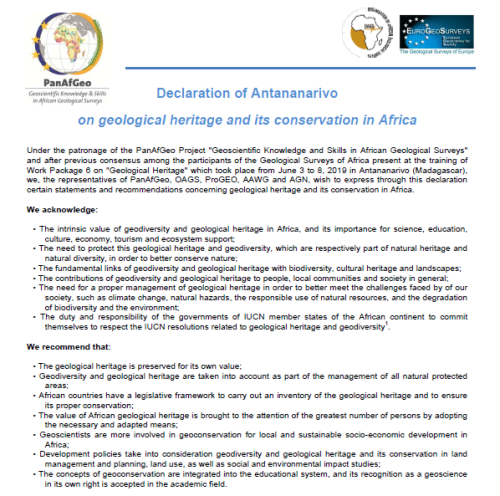
Declaration of Antananarivo on geological heritage and its conservation in Africa

Under the patronage of the PanAfGeo Project “Geoscientific Knowledge and Skills in African Geological Surveys” and after previous consensus among the participants of the Geological Surveys of Africa present at the training of Work Package 6 on “Geological Heritage” which took place from June 3 to 8, 2019 in Antananarivo (Madagascar), we, the representatives of PanAfGeo, OAGS, ProGEO, AAWG and AGN, wish to express through this declaration certain statements and recommendations concerning geological heritage and its conservation in Africa.

We acknowledge: 

  • The intrinsic value of geodiversity and geological heritage in Africa, and its importance for science, education, culture, economy, tourism and ecosystem support;
  • The need to protect this geological heritage and geodiversity, which are respectively part of natural heritage and natural diversity, in order to better conserve nature;
  • The fundamental links of geodiversity and geological heritage with biodiversity, cultural heritage and landscapes;
  • The contributions of geodiversity and geological heritage to people, local communities and society in general;
  • The need for a proper management of geological heritage in order to better meet the challenges faced by of our society, such as climate change, natural hazards, the responsible use of natural resources, and the degradation of biodiversity and the environment;
  • The duty and responsibility of the governments of IUCN member states of the African continent to commit themselves to respect the IUCN resolutions related to geological heritage and geodiversity1.

We recommend that: 

  • The geological heritage is preserved for its own value;
  • Geodiversity and geological heritage are taken into account as part of the management of all natural protected areas;
  • African countries have a legislative framework to carry out an inventory of the geological heritage and to ensure its proper conservation;
  • The value of African geological heritage is brought to the attention of the greatest number of persons by adopting the necessary and adapted means;
  • Geoscientists are more involved in geoconservation for local and sustainable socio-economic development in Africa;
  • Development policies take into consideration geodiversity and geological heritage and its conservation in land management and planning, land use, as well as social and environmental impact studies;
  • The concepts of geoconservation are integrated into the educational system, and its recognition as a geoscience in its own right is accepted in the academic field.

1– Including IUCN Resolution 4.040 (Conservation of Geodiversity and Geological Heritage), IUCN Resolution 5.048 (Enhancing and Conserving Geological Heritage in the IUCN Program 2013-2016), and IUCN Resolution 6.083 (Conservation of Moveable Geological Heritage).

Signed at Antananarivo, the 8th of June, 2019.

Media Release | Training session on the Mineral Resources Assessment in Lobatse, Botswana

WP2 S7 – Mineral Resources Assessment from 9th to 20th September 2019

 TRAINING DESCRIPTION:

Mineral resources constitutes one of the main interests for staff of African Geological Surveys.
The training in Lobatse, Botswana, will be the seventh training session on Mineral Resources Assessment organised by WP2 during the PanAfGeo project 2017-2019. The host is the Botswana Geoscience Institute (BGI).

THE MAIN OBJECTIVEs OF THE TRAINING are:

• Enhance the skills and knowledge of the staffs coming from Geological Surveys in different African countries, on mineral resources, and many different commodities and deposit types
• Give guidelines to how to evaluate raw materials, such as metals, industrial rocks and minerals available in their countries.
• Facilitate sustainable management of mineral resources.

THE TRAINING PROGRAMME consists of a range of topics related to mineral resources such as:

• Evaluation of metallic ore and industrial mineral potential
• Evaluation of resources suitable for construction materials, dimension stones and aggregates, agrominerals and development minerals
• Mineral resource reporting according to current international industrial standards
• Prospectivity mapping: How and why; real-life examples
• Assessment of undiscovered mineral resources with application of certain methods
• Drill core logging exercises
• Visit to an industrial-scale mine
• Mineral policies and the international mining sector, promotion and marketing of minerals and mineral potential

AT THE END OF THE TRAINING the participants will understand more on how the different mineral deposit types form and why they are where they are, how they are explored, evaluated and sustainably exploited.

They will also learn about modern exploration methods and interpretation. Also their understanding on how the global mining sector works will increase and they know how to promote sustainable use of mineral resources of a country.

The training will be in English.

Media Release | Training session on the artisanal and small scale mining in West Africa

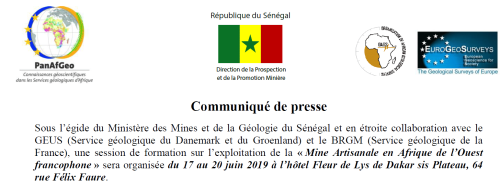
Sous l’égide du Ministère des Mines et de la Géologie du Sénégal et en étroite collaboration avec le GEUS (Service géologique du Danemark et du Groenland) et le BRGM (Service géologique de la France), une session de formation sur l’exploitation de la « Mine Artisanale en Afrique de l’Ouest francophone » sera organisée du 17 au 20 juin 2019 à l’hôtel Fleur de Lys de Dakar sis Plateau, 64 rue Félix Faure.

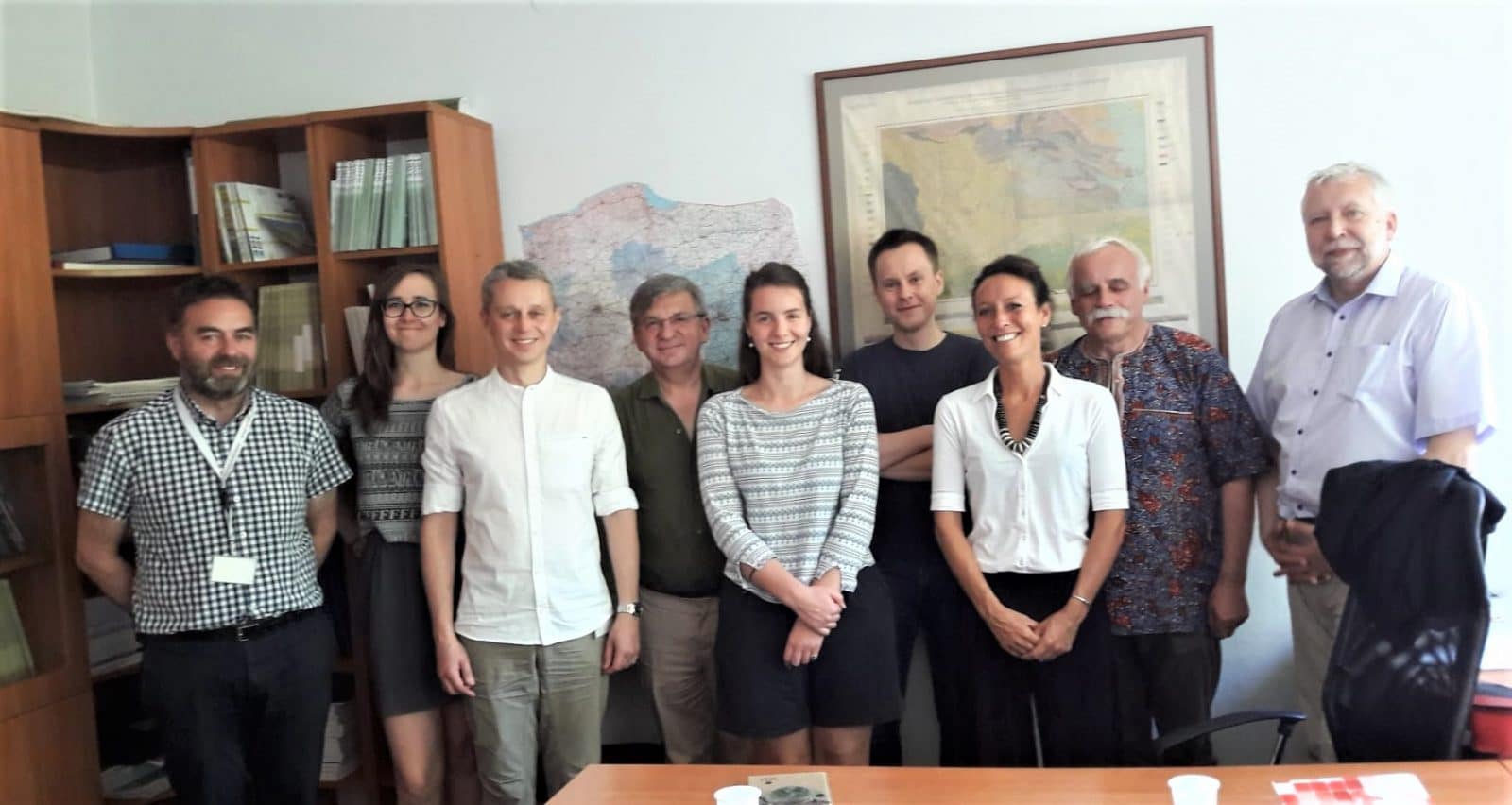
EuroGeoSurveys & Polish Geological Institute at PanAfGeo meeting in Poland

PanAfGeo project meeting between EuroGeoSurveys and Polish Geological Institute happened on 11 June 2019 in Warsaw, Poland.

The meeting had around 10 participants and a wide range of topics were deliberated. There was great discussions about ongoing PanAfGeo activities, the project’s future perspectives and collaboration.

https://business-hall.khm.gov.ua/ https://cnap.khm.gov.ua/ https://shevchenko.khm.gov.ua/ https://veteran.khm.gov.ua/ https://zonbox.pl/