PanAfGeo Logo
Calendar Icon
EU Emblem

A big step forward in strengthening science for society in Africa

PanAfGeo has achieved unanimous consensus: from feasibility study to project?

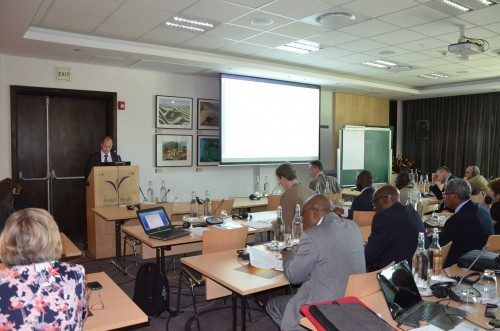
From the 8th to 10th February 2015, several fruitful workshops and bilateral meetings took place in Cape Town, South Africa, on the feasibility study, that has conceived PanAfGeo, an ambitious project, aiming at increasing knowledge and skills in African Geological Surveys. PanAfGeo is focused on establishing long-term strategic cooperation in several areas such as governance of natural resources, sustainable exploitation of non-energy mineral resources, prevention and mitigation of natural and man-made disasters and support to the development of the local mining sector.

PanAfGeo comes as a result of increasing cooperation between EuroGeoSurveys (EGS) and the Organisation of African Geological Surveys (OAGS), with the support of several key stakeholders such as the EC, AUC, UNESCO, UNECA/AMDC, UNDP and the World Bank amongst others.The preliminary phase of PanAfGeo, a joint EGS-OAGS effort to produce a feasibility study, is now complete. During a series of workshops, the study underwent a full review from representatives of the African Union Commission, European Union – including DG GROW and DG DEVCO from the European Commission – UNESCO, Geological Society of Africa and several others, which expressed unanimous support for an implementation phase.Mr Roeland van de Geer, Ambassador of the European Union to South Africa, declared “There is a need to overcome the disparities in Africa that are based on differed wealth, in strengthening the national institutions such as National Geological Surveys and the Organisation of African Geological Surveys”.Africa is home to 30% of the world’s reserves of natural resources including several strategic and critical minerals. However its share of the global metal production is minor and has not developed largely compared to e.g. Asia or Latin America, whilst the world’s demand of minerals is still increasing. In this framework the African Geological Surveys can play an crucial role.

Mr Jonathan van Meerbeeck – Team Leader of Pan-African Programme, from the European Commission DG DEVCO – has highlighted the necessity to increase African GDP not only through better and safer exploration of the African mining capability, but also through an improvement of related tourism. Geoheritage in Africa, for instance, can contribute financially to the local communities, can increase the national GDP and help guarantee environmental sustainability. Only 5% of African GDP is produced by tourism. In this context the European Commission expressed its interest to provide significant funding towards the implementation of the project over a period of six years.

Full consensus has been also demonstrated by the 40 African Geological Surveys present, that believe sustainable development in all sectors can be possible only through strengthening science for society in Africa, as they have mentioned in their statement. Training improvements, sharing best practice and the introduction of innovative techniques are the starting points to reinforce skills and experience of the African National Geological Surveys.

The next step required is to gather the support of the African Union. Ms. Fatima Acyl, African Union Commissioner for Trade and Industry confirmed her great interest in the project, suggesting the need to follow the needed formal procedures, in order to brief the African Union member countries competent Ministers. In order to get their feedback, she has undertaken to try to organise an Extraordinary Ministerial Summit in September 2015 in order to seal their final approval.In the meantime, the High Level Conference on ‘Infrastructures for Africa’ co-organised by the European Union and the African Union, to be held on Thursday 19th and Friday 20th March 2015 in Brussels, will include a specific session on geological infrastructures where the PanAfGeo project will be discussed.
PanAfGeo has achieved unanimous consensus: from feasibility study to project?

From the 8th to 10th February 2015, several fruitful workshops and bilateral meetings took place in Cape Town, South Africa, on the feasibility study, that has conceived PanAfGeo, an ambitious project, aiming at increasing knowledge and skills in African Geological Surveys.PanAfGeo is focused on establishing long-term strategic cooperation in several areas such as governance of natural resources, sustainable exploitation of non-energy mineral resources, prevention and mitigation of natural and man-made disasters and support to the development of the local mining sector. PanAfGeo comes as a result of increasing cooperation between EuroGeoSurveys (EGS) and the Organisation of African Geological Surveys (OAGS), with the support of several key stakeholders such as the EC, AUC, UNESCO, UNECA/AMDC, UNDP and the World Bank amongst others.The preliminary phase of PanAfGeo, a joint EGS-OAGS effort to produce a feasibility study, is now complete. During a series of workshops, the study underwent a full review from representatives of the African Union Commission, European Union – including DG GROW and DG DEVCO from the European Commission – UNESCO, Geological Society of Africa and several others, which expressed unanimous support for an implementation phase.Mr Roeland van de Geer, Ambassador of the European Union to South Africa, declared “There is a need to overcome the disparities in Africa that are based on differed wealth, in strengthening the national institutions such as National Geological Surveys and the Organisation of African Geological Surveys”.Africa is home to 30% of the world’s reserves of natural resources including several strategic and critical minerals. However its share of the global metal production is minor and has not developed largely compared to e.g. Asia or Latin America, whilst the world’s demand of minerals is still increasing. In this framework the African Geological Surveys can play an crucial role.Mr Jonathan van Meerbeeck – Team Leader of Pan-African Programme, from the European Commission DG DEVCO – has highlighted the necessity to increase African GDP not only through better and safer exploration of the African mining capability, but also through an improvement of related tourism. Geoheritage in Africa, for instance, can contribute financially to the local communities, can increase the national GDP and help guarantee environmental sustainability. Only 5% of African GDP is produced by tourism. In this context the European Commission expressed its interest to provide significant funding towards the implementation of the project over a period of six years.Full consensus has been also demonstrated by the 40 African Geological Surveys present, that believe sustainable development in all sectors can be possible only through strengthening science for society in Africa, as they have mentioned in their statement. Training improvements, sharing best practice and the introduction of innovative techniques are the starting points to reinforce skills and experience of the African National Geological Surveys.The next step required is to gather the support of the African Union. Ms. Fatima Acyl, African Union Commissioner for Trade and Industry confirmed her great interest in the project, suggesting the need to follow the needed formal procedures, in order to brief the African Union member countries competent Ministers. In order to get their feedback, she has undertaken to try to organise an Extraordinary Ministerial Summit in September 2015 in order to seal their final approval.In the meantime, the High Level Conference on ‘Infrastructures for Africa’ co-organised by the European Union and the African Union, to be held on Thursday 19th and Friday 20th March 2015 in Brussels, will include a specific session on geological infrastructures where the PanAfGeo project will be discussed.

PanAfGeo has achieved unanimous consensus: from feasibility study to project?

From the 8th to 10th February 2015, several fruitful workshops and bilateral meetings took place in Cape Town, South Africa, on the feasibility study, that has conceived PanAfGeo, an ambitious project, aiming at increasing knowledge and skills in African Geological Surveys.PanAfGeo is focused on establishing long-term strategic cooperation in several areas such as governance of natural resources, sustainable exploitation of non-energy mineral resources, prevention and mitigation of natural and man-made disasters and support to the development of the local mining sector. PanAfGeo comes as a result of increasing cooperation between EuroGeoSurveys (EGS) and the Organisation of African Geological Surveys (OAGS), with the support of several key stakeholders such as the EC, AUC, UNESCO, UNECA/AMDC, UNDP and the World Bank amongst others.The preliminary phase of PanAfGeo, a joint EGS-OAGS effort to produce a feasibility study, is now complete. During a series of workshops, the study underwent a full review from representatives of the African Union Commission, European Union – including DG GROW and DG DEVCO from the European Commission – UNESCO, Geological Society of Africa and several others, which expressed unanimous support for an implementation phase.Mr Roeland van de Geer, Ambassador of the European Union to South Africa, declared “There is a need to overcome the disparities in Africa that are based on differed wealth, in strengthening the national institutions such as National Geological Surveys and the Organisation of African Geological Surveys”.Africa is home to 30% of the world’s reserves of natural resources including several strategic and critical minerals. However its share of the global metal production is minor and has not developed largely compared to e.g. Asia or Latin America, whilst the world’s demand of minerals is still increasing. In this framework the African Geological Surveys can play an crucial role.Mr Jonathan van Meerbeeck – Team Leader of Pan-African Programme, from the European Commission DG DEVCO – has highlighted the necessity to increase African GDP not only through better and safer exploration of the African mining capability, but also through an improvement of related tourism. Geoheritage in Africa, for instance, can contribute financially to the local communities, can increase the national GDP and help guarantee environmental sustainability. Only 5% of African GDP is produced by tourism. In this context the European Commission expressed its interest to provide significant funding towards the implementation of the project over a period of six years.Full consensus has been also demonstrated by the 40 African Geological Surveys present, that believe sustainable development in all sectors can be possible only through strengthening science for society in Africa, as they have mentioned in their statement. Training improvements, sharing best practice and the introduction of innovative techniques are the starting points to reinforce skills and experience of the African National Geological Surveys.The next step required is to gather the support of the African Union. Ms. Fatima Acyl, African Union Commissioner for Trade and Industry confirmed her great interest in the project, suggesting the need to follow the needed formal procedures, in order to brief the African Union member countries competent Ministers. In order to get their feedback, she has undertaken to try to organise an Extraordinary Ministerial Summit in September 2015 in order to seal their final approval.In the meantime, the High Level Conference on ‘Infrastructures for Africa’ co-organised by the European Union and the African Union, to be held on Thursday 19th and Friday 20th March 2015 in Brussels, will include a specific session on geological infrastructures where the PanAfGeo project will be discussed.

3rd YES Congress and the 25th Colloquium of African Geology (CAG25)

The 3rd YES Congress and the 25th Colloquium of African Geology (CAG25) have been successfully held from August 11th-13th and from August 14th-16th 2014 respectively, at the Mwalimu Julius Nyerere International Convention Centre in Dar es Salaam, Tanzania. The events have been jointly organized with the support of the Geological Society of Africa (GSAf) and the YES Network in collaboration with the Ministry of Energy and Minerals of the government of Tanzania.
Both congresses were inaugurated by the Vice-President of Tanzania along with the Minister of Minerals of Tanzania and the President of the Geological Society of Africa. The former President of Tanzania and the Director of the Tanzanian Geological Survey were also there for the Opening Ceremony of the CAG25.

Young Geoscientists for the future of the Earth
The YES Network (Young Earth Scientist) is an international association of early-career geoscientists who are primarily under the age of 35 years and are from universities, geoscience organizations and companies from all around the world. The YES Network was formed as a result of the International Year of Planet Earth in 2007. Nearly 500 participants from 46 different countries attended the 3rd YES Congress, with the theme “Bridging Geo-generations into Global Earth Sciences Integrations”. Seven parallel sessions were organised and participants, including Earth scientists from academia, industry, Geoscience organizations and decision makers, discussed key topics in sessions including Geoscience in Society, Mineral and Energy Resources, Geohazards, Hydrogeology and Climate Change, with a special emphasis on the African continent. The congress also included workshops on Geochemistry, Geoparks, Mathematical Geology and Geology for Global Development. The participants were really interested and happy with the outputs of the workshops, and for broadening their knowledge and awareness on technical information from all around the world.
The announcement, made by our Secretary General Luca Demicheli, of the coming registration of the YES Network as a non-profit organization hosted by EuroGeoSurveys was one of the main highlights of this event.
A step forward for African Geology

The Colloquium of African Geology (CAG) is a major biannual meeting of the GSAf where earth scientists have opportunities to present their research results on topics related to Africa and surrounding areas on a continental and international scale. The theme for the CAG25 was “Earth Sciences for Improving Livelihood in Africa”. The sharing of technical and geo-scientific information among geoscientists, engineers and academia has contributed to enhance the development of the minerals, oil and gas sector in the continent, and also their use and application in the future.
The Organisation of African Geological Surveys (OAGS) and EuroGeoSurveys took the opportunity of this Congress to organise a special Information Session on the project “Geoscientific knowledge and skills in African Geological Surveys”. The session provided insight and information on a feasibility study undertaken to assess the current state of Geological Surveys in Africa and to develop a strategy for sustainable strengthening of African countries´ geological administrations. The session consisted of presentations from representatives and leading experts from both African and European Geological Surveys, and has been a great success with more than 70 participants coming from international organisations, companies and universities.[:fr]The 3rd YES Congress and the 25th Colloquium of African Geology (CAG25) have been successfully held from August 11th-13th and from August 14th-16th 2014 respectively, at the Mwalimu Julius Nyerere International Convention Centre in Dar es Salaam, Tanzania. The events have been jointly organized with the support of the Geological Society of Africa (GSAf) and the YES Network in collaboration with the Ministry of Energy and Minerals of the government of Tanzania.
Both congresses were inaugurated by the Vice-President of Tanzania along with the Minister of Minerals of Tanzania and the President of the Geological Society of Africa. The former President of Tanzania and the Director of the Tanzanian Geological Survey were also there for the Opening Ceremony of the CAG25.

Young Geoscientists for the future of the Earth
The YES Network (Young Earth Scientist) is an international association of early-career geoscientists who are primarily under the age of 35 years and are from universities, geoscience organizations and companies from all around the world. The YES Network was formed as a result of the International Year of Planet Earth in 2007. Nearly 500 participants from 46 different countries attended the 3rd YES Congress, with the theme “Bridging Geo-generations into Global Earth Sciences Integrations”. Seven parallel sessions were organised and participants, including Earth scientists from academia, industry, Geoscience organizations and decision makers, discussed key topics in sessions including Geoscience in Society, Mineral and Energy Resources, Geohazards, Hydrogeology and Climate Change, with a special emphasis on the African continent. The congress also included workshops on Geochemistry, Geoparks, Mathematical Geology and Geology for Global Development. The participants were really interested and happy with the outputs of the workshops, and for broadening their knowledge and awareness on technical information from all around the world.
The announcement, made by our Secretary General Luca Demicheli, of the coming registration of the YES Network as a non-profit organization hosted by EuroGeoSurveys was one of the main highlights of this event.
A step forward for African Geology

The Colloquium of African Geology (CAG) is a major biannual meeting of the GSAf where earth scientists have opportunities to present their research results on topics related to Africa and surrounding areas on a continental and international scale. The theme for the CAG25 was “Earth Sciences for Improving Livelihood in Africa”. The sharing of technical and geo-scientific information among geoscientists, engineers and academia has contributed to enhance the development of the minerals, oil and gas sector in the continent, and also their use and application in the future.
The Organisation of African Geological Surveys (OAGS) and EuroGeoSurveys took the opportunity of this Congress to organise a special Information Session on the project “Geoscientific knowledge and skills in African Geological Surveys”. The session provided insight and information on a feasibility study undertaken to assess the current state of Geological Surveys in Africa and to develop a strategy for sustainable strengthening of African countries´ geological administrations. The session consisted of presentations from representatives and leading experts from both African and European Geological Surveys, and has been a great success with more than 70 participants coming from international organisations, companies and universities.[:pt]The 3rd YES Congress and the 25th Colloquium of African Geology (CAG25) have been successfully held from August 11th-13th and from August 14th-16th 2014 respectively, at the Mwalimu Julius Nyerere International Convention Centre in Dar es Salaam, Tanzania. The events have been jointly organized with the support of the Geological Society of Africa (GSAf) and the YES Network in collaboration with the Ministry of Energy and Minerals of the government of Tanzania.
Both congresses were inaugurated by the Vice-President of Tanzania along with the Minister of Minerals of Tanzania and the President of the Geological Society of Africa. The former President of Tanzania and the Director of the Tanzanian Geological Survey were also there for the Opening Ceremony of the CAG25.

Young Geoscientists for the future of the Earth
The YES Network (Young Earth Scientist) is an international association of early-career geoscientists who are primarily under the age of 35 years and are from universities, geoscience organizations and companies from all around the world. The YES Network was formed as a result of the International Year of Planet Earth in 2007. Nearly 500 participants from 46 different countries attended the 3rd YES Congress, with the theme “Bridging Geo-generations into Global Earth Sciences Integrations”. Seven parallel sessions were organised and participants, including Earth scientists from academia, industry, Geoscience organizations and decision makers, discussed key topics in sessions including Geoscience in Society, Mineral and Energy Resources, Geohazards, Hydrogeology and Climate Change, with a special emphasis on the African continent. The congress also included workshops on Geochemistry, Geoparks, Mathematical Geology and Geology for Global Development. The participants were really interested and happy with the outputs of the workshops, and for broadening their knowledge and awareness on technical information from all around the world.
The announcement, made by our Secretary General Luca Demicheli, of the coming registration of the YES Network as a non-profit organization hosted by EuroGeoSurveys was one of the main highlights of this event.
A step forward for African Geology

The Colloquium of African Geology (CAG) is a major biannual meeting of the GSAf where earth scientists have opportunities to present their research results on topics related to Africa and surrounding areas on a continental and international scale. The theme for the CAG25 was “Earth Sciences for Improving Livelihood in Africa”. The sharing of technical and geo-scientific information among geoscientists, engineers and academia has contributed to enhance the development of the minerals, oil and gas sector in the continent, and also their use and application in the future.
The Organisation of African Geological Surveys (OAGS) and EuroGeoSurveys took the opportunity of this Congress to organise a special Information Session on the project “Geoscientific knowledge and skills in African Geological Surveys”. The session provided insight and information on a feasibility study undertaken to assess the current state of Geological Surveys in Africa and to develop a strategy for sustainable strengthening of African countries´ geological administrations. The session consisted of presentations from representatives and leading experts from both African and European Geological Surveys, and has been a great success with more than 70 participants coming from international organisations, companies and universities.

5th EU-Africa Business Forum in “Engaging the private sector in sustainable and inclusive growth”

The European Union – Africa Business Forum in “Engaging the private sector in sustainable and inclusive growth” has been a great success for the Geological Surveys of Africa and Europe engaged at the roundtable on ‘Raw materials and governance: Managing natural resources for inclusive development in Africa‘. The 5th EU-Africa Business Forum took place on the eve of the EU-Africa Summit, with the intention to give inputs and prepare the Summit 2 days-discussions (31 March-1 April). The Forum brought together more than 500 high-level representatives from European and African business, politics and public institutions. It developed through 12 Roundtables on various topics that focused on common challenges such as young people in today’s economies, the role of banks inclusive growth and financing issues for Small and Medium Enterprises (SMEs) and on specific issues such as raw material, risk capital, sustainable energy or space cooperation. During the Business Forum opening ceremony, the European Commission Vice President, Antonio Tajani, expressed his commitment to foster geological collaboration, in accordance with the EU Raw Material Diplomacy. This should benefit local populations and European companies that adopt a business model ethic compatible with the EU legislation. The President of European Commission, José Manuel Barroso, and the chairperson of the African Union Commission, Nkosazana Dlamini Zuma, reaffirmed the strategy to strengthen African sustainable development (infrastructure, agriculture, tourism, raw materials, young education) while enhancing EU business and trade with Africa. EuroGeoSurveys was invited at the Roundtable on Raw Materials, which was chaired in cooperation with the Organization of African Geological Surveys (OAGS), represented by the OAGS President Mrs Gabi Schneider. The participants, that included EurominesBusiness Europe and other industrial players and institutions, discussed how to enhance a sustainable exploitation of the minerals wealth of the continent leading to a sustainable economic growth, along four axes: governance, infrastructure, knowledge base and waste management. Mrs Fatima Haram Acyl, African Commissioner for Trade and Industry, and Mr Karel De Gucht, European Commissioner for Trade were present at the debate. Mrs Acyl expressed full support to the geological cooperation, considered one of the most important and urgent needs to understand minerals resources potential in Africa and its sustainable development. It has emerged that geological knowledge and information should be increased by strengthening Geological Surveys capacity and geological cooperation, as indeed stated by Mrs Acyl. The roundtable stressed the importance of developing a good policy framework to attract investments, promote skills development and business education in the sector. This process should ensure environmental protection and the participation of local population in all part of the processes, also in the form of consultation. Geological Surveys data production and access has a remarkable impact, especially for business and development opportunities and to enable African countries to take informed decisions. In fact, the debate highlighted the importance of information in all areas, including geological knowledge, information on trade, education and business schools development, ownership of data, information access, access to data and related pricing policies. The Organisation of African Geological Surveys (OAGS) was pointed as the most suited body to coordinate common actions and synergies of individual African Geological Surveys, and to propose solutions and actions to improve the capacity of African countries to develop and control geological information. However, decisions in this direction, including the further empowerment of OAGS, should be taken at African Union level. Particular importance was also paid to the development of the artisanal and small scale mining and also to address the issue of conflict minerals. In line with the Forum purposes, the roundtable also engaged in the topics of education and development of skills for young people in Geology, not only during University but also through business schools. They have been considered key assets that require the coordination at continental level. The policy framework should support and facilitate public-private partnerships, which must lead to exploit sustainably the resources offered by the African continent. The public and private sectors should partner together, overcoming possible conflicts like in the case of infrastructure development. Last but not least, everybody agreed that Africa needs a structural transformation that requires time and that is unfortunately long overdue. This is the main reason to consider the key of success establishing long term integrated strategies that will not let such a transformation awaited any longer.

https://business-hall.khm.gov.ua/ https://cnap.khm.gov.ua/ https://shevchenko.khm.gov.ua/ https://veteran.khm.gov.ua/ https://zonbox.pl/