PanAfGeo Logo
Calendar Icon
EU Emblem

UNESCO’s International Geoscience and Geoparks Programme (IGGP) Newsletter & PanAfGeo-2 Project

Check out the 2nd issue of UNESCO’s International Geoscience and Geoparks Programme (IGGP) newsletter.

The newsletter highlights the IGGP’s recent progress and activities to support the UNESCO Member States to facilitate international scientific cooperation in the geosciences. The IGGP mission includes promoting sustainable use of natural resources, advancing new initiatives related to geo-diversity and geo-heritage and geohazards risk mitigation.

On-Page 10 of the IGGP newsletter, the PanAfGeo-2 Project activities and UNESCO’s role are emphasized. Click here to view/download the newsletter.

PanAfGeo-2: Kick-Off Meeting – Building on an Already Unique Training Programme

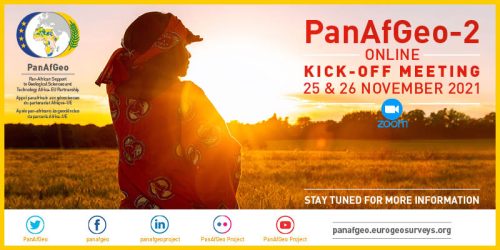
The PanAfGeo community is delighted to announce the official launch of the second phase of the PanAfGeo project, at an online meeting on 25th – 26th November 2021.

PanAfGeo Phase 2 builds on the success of Phase 1, a training programme implementing the transfer of knowledge between European and African Geological Surveys and institutional strengthening of African national administrations in charge of geology and mining. The project will continue to serve as a reference of a continental scale partnership and development project in the field of geosciences.

PanAfGeo-2 is implemented through a project consortium, coordinated by BRGM, the Geological Survey of France, including 11 European Geological Surveys and EuroGeoSurveys (EGS), together with the Organisation of African Geological Surveys (OAGS) and national Geological Surveys of Africa. The project supports the training of geoscientific staff from African Geological Surveys through a diverse range of innovative training methods on a variety of geoscientific and governance related topics.

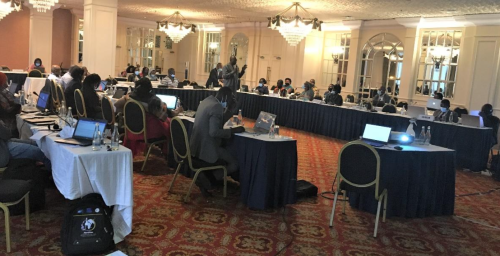
The opening meeting, held online on 25th – 26th November 2021, included approximately 70 representatives from across Europe and Africa, representing some 50 African and European countries. Attendees included some of the main contributors to the project work packages, representatives of Geological Surveys in Europe and Africa, UNESCO, the African Union Commission, the European Union, and other stakeholders.

The main panel for the meeting comprised:
• Jean-Claude Guillaneau, PanAfGeo Coordinator (Moderator)
• Felix Toteu, PanAfGeo Advisory Board President
• Frank Mugyenyi, African Union Commission/African Minerals Development Centre (AMDC)
• Fabio di Stefano, European Commission, DG International Partnerships
• Rokhaya Samba Diene, President of the Organisation of African Geological Surveys (OAGS)

The panel reiterated the need for ongoing strong partnership between the EU and the African national geological surveys, and were united in their praise for the community that has been created and the advances that have been made during Phase 1 of the project. The many successes of the project so far were highlighted, as well as the urgency required in tackling many of the issues that still remain in the continent, in particular the participation of women and children in the mining industry. Ozlem Lopez of UNESCO brought the congratulations of the organisation for all the work that has been done so far, and pledged support on behalf of UNESCO for the new phase.

PanAfGeo-2 was declared officially launched by Felix Toteu.

The presentations from each of the work packages made it clear that while much has been done to support the African community of geological surveys and the work that they do across the continent, there was much that could still be achieved, and anticipation for the positive outcomes of phase 2 were high. Future targets were unveiled, together with acknowledgments of the excellent work done so far. Areas of concern included the effect of the Covid-19 pandemic, and steps will be taken to ensure that the project continues in spite of the uncertainty around travel and meeting face to face.

Click here to view/download the kick-off meeting report.
PanAfGeo-2 participation at the African Union Expert Group Meetings

The PanAfGeo community is glad to announce its presence at the African Union Expert Group Meetings held in Nairobi, Kenya between 01 – 05 November 2021.

The PanAfGeo was represented by Mr. Jean-Claude Guillaneau (the PanAfGeo-2 Coordinator). The expert group meeting was centered on the following objectives,
1) Developing guidelines on the ASM Strategy
2) Reviewing the progress of the development of Model Minerals Laws, and
3) Progressing towards the implementation of the African Minerals Geoscience Initiative “AMGI”.

Mr Guillaneau participated in the different expert group meetings and also made a presentation about PanAfGeo-2.

Click here to view/download this report.

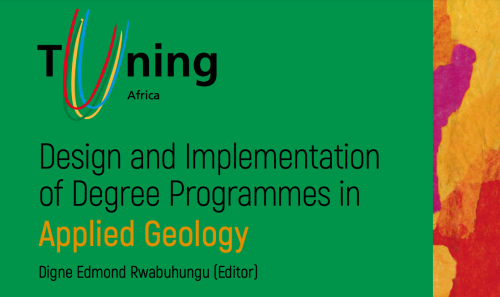
Tuning Africa Project Phase II – Design and Implementation of Degree Programmes in Applied Geology

The harmonisation of higher education in Africa is a multidimensional process that promotes the development of an integrated higher education space on the continent of Africa. The objective is to achieve collaboration across borders, sub-regionally and regionally, in curriculum development, educational standards and quality assurance, joint structural convergence, consistency of systems as well as compatibility, recognition and transferability of degrees to facilitate mobility. Harmonisation is necessary for achievement of the African Union vision of integration, peace and prosperity.

Tuning Africa was adopted as a possible instrument to advance the African Union’s harmonisation agenda, in collaboration with the EU through the Joint Africa-EU Strategy.  Implementing a second phase of Tuning was one of the commitments taken at the 2014 Africa-EU Summit in 2014 in Brussels, as a follow-up to the very successful pilot phase which took place between 2011 and 2013. At the November 2017 Africa-EU Summit in Abidjan, Heads of State committed to deepening their collaboration and exchange in education, aiming at increasing the employability of young people bearing in mind that investing in youth and future generations in Africa is a prerequisite for building a sustainable future. In this context, further concrete initiatives in the field of higher education which aim to enhance relevance and the quality of education and training will be encouraged.

By contributing to the harmonisation of higher education in Africa, Tuning Africa is complementing Erasmus+, the Intra-Africa academic mobility programme and the Nyerere scheme; thereby enhancing the mutual recognition of academic qualifications and facilitating exchanges and mobility of students and staff across the continent and with Europe. This is instrumental for acquiring key skills and competences that are important for employability, facilitating collaborative research addressing common challenges, and for ensuring
relevant and quality education. The dialogue on credits and a common credit system for Africa is another major deliverable for Africa. All these initiatives are in line with the Continental Education Strategy for Africa as well as Africa’s Agenda 2063 which calls for an education and skills revolution.

Tuning Africa has provided a platform for dialogue on quality assurance and the improvement of teaching, learning and assessment in higher education. Bringing together academia and employers, and importantly in this second phase, the active involvement of students, has been crucial. The success of Tuning Africa has been the involvement of a critical mass of universities and stakeholders, the ownership and commitment of all involved, as well as a transparent and credible leadership. The AUC and EC are grateful to all the African and European experts involved in the production of this book, which is an outcome of the Joint Africa-EU Partnership Harmonisation and Tuning Africa 2 initiative.

To know more, click here to view/download the report.

Official brochure of the PanAfGeo-2 Project

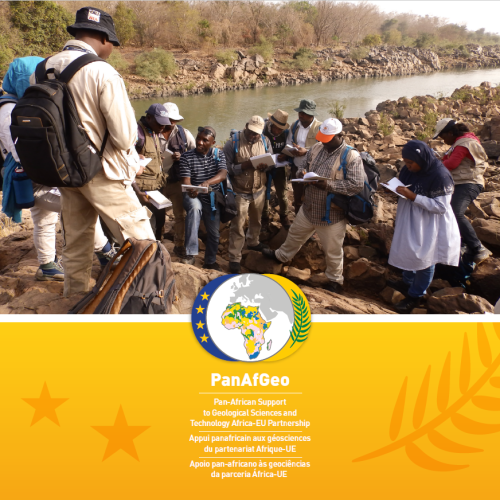
The first brochure of the PanAfGeo-2 Project illustrates the planned activities, objectives, consortium members and an overview of the work packages in English, French and Portuguese versions. The brochure also presents the result of PanAfGeo-1. Click here to view/download the PanAfGeo-2 brochure.

About PanAfGeo-2:

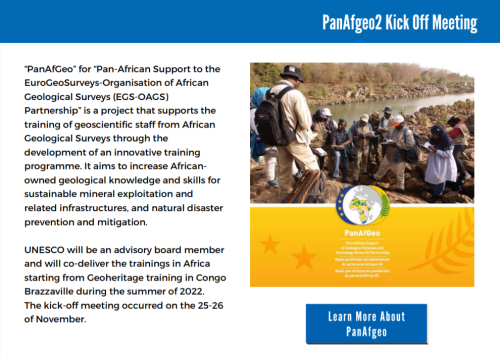
The PanAfGeo-2 allows trainees to acquire state-of-the-art tools, methods and experienced knowledge in 8 geoscientific skills. The project supports the training of geoscientific staff from African Geological Surveys through the diversity of innovative training methods. The project will embrace the acquisition and development of the professional skills that complement the participants’ technical qualifications, under the guidance of African and European geoscientists with an extensive international experience.

PanAfGeo: The Second Phase Begins!

The PanAfGeo community is pleased to announce the launching of the PanAfGeo second phase (PanAfGeo-2), which will continue to build on the first phase project’s achievements over the next three years.

PanAfGeo, an EU co-funded initiative that began in 2016, contributed to the transfer of knowledge between European and African Geological Surveys. PanAfGeo also ensured the institutional strengthening of many African national administrations in charge of geology and mining.

With the backing of the European Union and the African Union through the Africa-EU Partnership, PanAfGeo-2 will continue to serve as a reference of an intercontinental cooperation and development project in the field of geosciences. PanAfGeo-2 is implemented through a project consortium, coordinated by the BRGM, the Geological Survey of France, and including 11 European Geological Surveys and the umbrella organization of the Geological Surveys in Europe, EuroGeoSurveys (EGS). Together with the Organisation of African Geological Surveys (OAGS) and African Geological Surveys, PanAfGeo-2 will develop a set of knowledge exchange programmes for African geoscientists to acquire state-of-the-art tools and learn new methods and skills in the following geoscientific competencies :

  1. Geoscientific Mapping
  2. Mineral Resources Assessment
  3. Artisanal & Small-Scale Mining
  4. Geoheritage & Geothermal energy
  5. Geohazards & Environmental Management of Mines
  6. Georesources Governance & OAGS/GSOs Institutional Strengthening
  7. Geoscientific Information Management
  8. Communication, Dissemination & Dialogue.

The project supports the training of geoscientific staff from African Geological Surveys through the diversity of innovative training methods. The project will embrace the acquisition and development of the professional skills that complement the participants’ technical qualifications, under the guidance of African and European geoscientists with an extensive international experience.

https://www.youtube.com/watch?v=Uw2u3ixdDws

PanAfGeo-2 also aims to support capacity building at the political, institutional, and technical level in Africa by focusing on georesources governance and, at an expert and management level, involvement of senior African geoscientists that would develop a long-term training for trainers approach with a view towards post-project activities.

All activities of PanAfGeo-2 shall reinforce the governance and sustainable management of georesources within the African-EU Partnership.

Click here to view/download this report in the following languages,

https://business-hall.khm.gov.ua/ https://cnap.khm.gov.ua/ https://shevchenko.khm.gov.ua/ https://veteran.khm.gov.ua/ https://zonbox.pl/